
Our Curriculum
The Early Years Foundation Stage (EYFS) ensures the needs and learning styles of each child are met, using a variety of resources and the whole nursery environment, indoor and outdoor. All documentation supporting the EYFS are available via www.foundationyears.org.uk. The Foundation Year’s website also includes a range of resources and contacts.
This is a critical stage as it helps your child get ready for school, as well as preparing them for their future learning and successes.
From birth until the age of 5 years old your child’s Early Years’ experience should be happy, active, exciting, fun and secure.
At St George's Nursery, our curriculum is guided by the Early Years Foundation Stage (EYFS) and informed by Birth to 5 Matters, ensuring every child receives a high-quality, inclusive and nurturing early education.
Birth to 5 Matters 2026 recognises that every child is unique and develops at their own pace. Rather than focusing on fixed milestones, it helps practitioners understand children's individual learning journeys, celebrate their achievements and plan meaningful experiences that build on their interests, strengths and next steps.
Our practitioners regularly observe children during their play and everyday experiences. These observations help us to:
- Understand each child's stage of development.
- Plan learning that follows children's interests and curiosity.
- Support children's next steps through play-based experiences.
- Provide appropriate challenge while recognising that children develop differently.
- Work closely with families to build a complete picture of each child's learning and development.
Learning is carefully planned across the seven areas of learning and development, ensuring children develop the knowledge, skills and confidence they need for school and for life.

Supporting children's emotional wellbeing is at the heart of everything we do. We use the Five to Thrive approach throughout the nursery because we know that secure relationships and positive interactions are essential for healthy brain development and lifelong learning.
Five to Thrive is based on five simple but powerful interactions that adults can use every day:
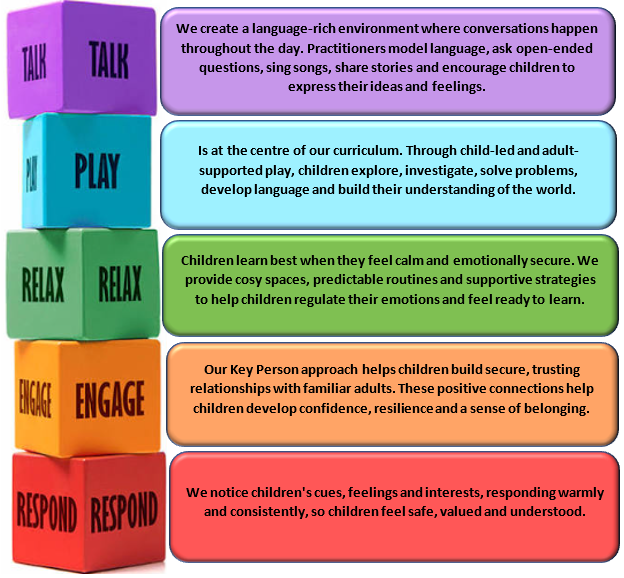

Children experience Five to Thrive every day through:
- Warm, responsive relationships with their Key Person.
- Daily circle times using resources such as the Colour Monster to explore emotions.
- Storytelling, singing and meaningful conversations.
- Child-led play both indoors and outdoors.
- Sensory and calming activities that support self-regulation.
- Small group nurture sessions that develop confidence, friendships and emotional wellbeing.
- Positive behaviour support that helps children understand and manage their feelings.
- Strong partnerships with parents to ensure consistency between home and nursery.
By combining the principles of Birth to 5 Matters with the nurturing approach of Five to Thrive, we create an environment where every child feels safe, respected and inspired to become a confident, curious and independent learner. Our aim is for every child to flourish emotionally, socially and academically, giving them the strongest possible foundations for their future learning.

Our curriculum is designed to ensure that every child has the opportunity to flourish, develop a love of learning and make progress from their individual starting points.
Children learn best through play, exploration, positive relationships and meaningful experiences. Our practitioners carefully observe children's interests and developmental progress, planning engaging activities that build upon what children already know and can do.

Our curriculum is designed to ensure that every child has the opportunity to flourish, develop a love of learning and make progress from their individual starting points.
We aim to:
- Provide a broad and balanced curriculum that supports learning across all seven areas of the EYFS, with particular emphasis on communication and language, personal, social and emotional development, and physical development as foundations for future learning.
- Recognise every child as an individual, valuing their interests, strengths, experiences, home languages, family backgrounds and different ways of learning.
- Develop confident communicators who can listen, express their ideas, build relationships, develop vocabulary and communicate their needs and feelings.
- Support emotional wellbeing by helping children recognise and express emotions, develop positive relationships, manage challenges and gradually build independence and resilience.
- Foster curiosity and creativity through opportunities to explore, investigate, imagine, solve problems and develop their own ideas.
- Develop early literacy and mathematical understanding through stories, songs, rhymes, mark-making, purposeful conversations, counting, pattern, shape and everyday problem-solving.
- Promote equality, diversity and inclusion, ensuring that all children feel safe, valued, respected and represented within our nursery community.
- Prepare children for their next stage of learning, including a positive and confident transition to school.

Our curriculum is implemented through a carefully planned balance of adult-led experiences, adult-guided learning and child-initiated play. We recognise that young children learn best when they feel secure, interested and motivated to explore their environment.
1. Play-Based Learning
Play is central to our curriculum. Through meaningful play, children develop knowledge, skills, language, creativity and understanding of the world around them.
Our indoor and outdoor provision offers opportunities for imaginative role play, small-world exploration, construction, creative activities, stories, songs, physical play, sensory experiences and investigation of natural materials.
Staff build on children's interests and ideas, introducing new experiences and extending learning through purposeful play.
2. The Seven Areas of Learning
Our curriculum covers all seven areas of the EYFS:
- Communication and Language: Developing listening, attention, understanding, speaking and vocabulary through conversations, stories, songs and rhymes.
- Personal, Social and Emotional Development: Building secure relationships, developing self-awareness, recognising feelings, learning to share and take turns, and developing independence.
- Physical Development: Developing gross and fine motor skills, coordination, balance, control and increasing awareness of personal health and self-care.
- Literacy: Developing a love of books, enjoying stories and rhymes, developing phonological awareness and exploring early writing and mark-making.
- Mathematics: Developing early number sense, counting, comparing quantities, recognising patterns, exploring shape and space, and using mathematical language in everyday experiences.
- Understanding the World: Exploring people, families, communities, living things, nature, materials, technology and the similarities and differences in the world around us.
- Expressive Arts and Design: Exploring music, movement, art, materials, imagination, storytelling, role play and creative self-expression
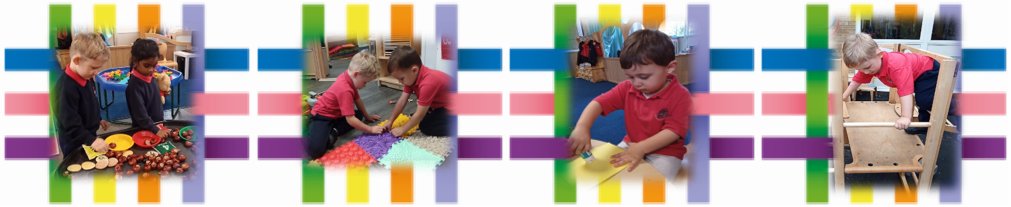
Learning is connected across the seven areas so that children can apply and extend their knowledge and skills in meaningful contexts.
3. The Characteristics of Effective Teaching and Learning
We encourage the three Characteristics of Effective Teaching and Learning throughout our provision:
- Playing and Exploring: Children investigate, explore, make discoveries and have a go at new experiences.
- Active Learning: Children develop concentration, persistence, motivation and pride in their achievements.
- Creating and Thinking Critically: Children develop their own ideas, make connections, solve problems and explore different ways of doing things.
Staff support children to become confident, independent learners who are willing to try, make mistakes and learn from their experiences.
4. Observation, Assessment and Responsive Planning
Staff use ongoing observations, professional knowledge and assessment to understand each child's development, interests and next steps.
Planning is informed by the EYFS, Development Matters, Birth to 5 Matters and our knowledge of the children. We consider children's starting points and developmental stages rather than expecting every child to follow the same pathway or learn at the same pace.
Through observation and assessment, staff identify emerging interests, recognise progress and plan meaningful opportunities to extend learning. Our focus-child approach enables key persons to develop a deeper understanding of individual children and work in partnership with their families to support learning and development.
Learning journals on Tapestry provide a record of children's experiences, achievements and developing skills.
5. High-Quality Interactions and Language Development
Warm, responsive relationships underpin effective teaching and learning. Staff listen carefully to children, model language, introduce new vocabulary, ask purposeful questions and provide appropriate support and challenge.
We use stories, singing, rhymes, conversations and everyday routines to develop communication and language. Staff adapt their interactions to meet children's individual needs, encouraging them to express themselves, think independently and build confidence.
6. An Enabling Indoor and Outdoor Environment
Our indoor and outdoor environments are carefully organised to encourage exploration, independence, creativity and purposeful play.
Continuous provision offers accessible resources and open-ended opportunities that children can revisit, develop and use in different ways. Natural materials, construction resources, creative equipment, books, small-world play and imaginative areas encourage children to follow their interests and develop new skills.
Adults observe how children use the environment and make adjustments to ensure that learning opportunities remain relevant, engaging and accessible to all.
7. Inclusion, SEND and Emotional Wellbeing
We are committed to ensuring that every child is supported to participate, belong and succeed. We recognise that children develop at different rates and may require different levels of support to access learning.
Our approach includes secure key-person relationships, differentiated experiences, appropriate adaptations, close observation and partnership with parents, carers and relevant professionals.
We place particular importance on children's emotional wellbeing. Through nurturing relationships and approaches such as Five to Thrive, we help children develop a sense of security, recognise their feelings, build positive relationships and begin to manage their emotions.
Where additional needs are identified, we work with families and appropriate professionals to plan support, monitor progress and review next steps.
8. Partnership with Parents and Carers
We recognise parents and carers as children's first and most enduring educators. Strong partnerships help us build a shared understanding of each child's needs, interests, experiences and development.
We encourage families to contribute to learning journals, share information about achievements and interests at home, participate in focus-child activities and attend meetings to discuss progress and next steps.
Regular communication and collaborative planning help us provide consistent, personalised support and celebrate each child's development.
9. Preparing for Transitions
We support children as they move into nursery, between groups and on to their next educational setting.
Through familiar routines, secure relationships, opportunities to develop independence and communication with receiving schools and families, we aim to make transitions positive and reassuring.
We work closely with parents and carers to ensure that children's strengths, needs and achievements are understood and that appropriate support is in place.

The impact of our curriculum is reflected in the progress children make from their individual starting points and in their growing confidence, independence, wellbeing and readiness for future learning.
We evaluate the effectiveness of our provision through:
- Progress and development: Children develop knowledge, skills and understanding across all seven areas of learning.
- Communication and language: Children increasingly listen, understand, communicate their needs and ideas, and develop their vocabulary.
- Emotional wellbeing and relationships: Children develop a sense of belonging, build positive relationships and increasingly recognise and express their feelings.
- Independence and resilience: Children become more confident in making choices, managing everyday routines, trying new experiences and persevering when learning is challenging.
- Engagement and curiosity: Children show interest, explore their environment, develop their own ideas and build on previous experiences.
- Early literacy and mathematics: Children develop the foundations for reading, writing, counting, mathematical thinking and problem-solving.
- Inclusion and individual progress: Children with additional needs receive appropriate support and opportunities to make meaningful progress.
- Partnership with families: Parents and carers contribute to children's learning journeys and share in recognising achievements and identifying next steps.
- Transition and school readiness: Children develop the communication, social, physical and learning behaviours that support a positive transition to school.
Staff use observations, learning journals, discussions with families, progress reviews and professional reflection to evaluate children's development and the effectiveness of the curriculum. Where progress or wellbeing indicates that further support is needed, we adapt provision and agree appropriate next steps.
We use this information to identify strengths, address gaps in learning, improve teaching and ensure that our curriculum continues to meet the needs of the children attending Dragons Nursery.

At St George's Nursery, we use Tapestry, a secure online learning journal, to record and celebrate your child's learning and development. Tapestry enables us to share observations, photographs, videos and assessments with parents, providing a real-time insight into your child's experiences and achievements at nursery.
Using Birth to 5 Matters and the Early Years Foundation Stage (EYFS), our practitioners observe children's interests, play and development to build a holistic picture of their learning. These observations help us identify each child's strengths, celebrate their achievements and plan meaningful next steps that are tailored to their individual needs.
Sharing Your Child's Learning
Parents and carers are an essential part of their child's learning journey. Through Tapestry you can:
- View your child's observations, photographs and videos.
- Celebrate milestones and achievements.
- See how your child's learning links to the EYFS and Birth to 5 Matters guidance.
- Receive updates from your child's Key Person.
- Add your own observations, photographs and comments from home.
- Share special moments, interests and achievements that help us understand your child even better.
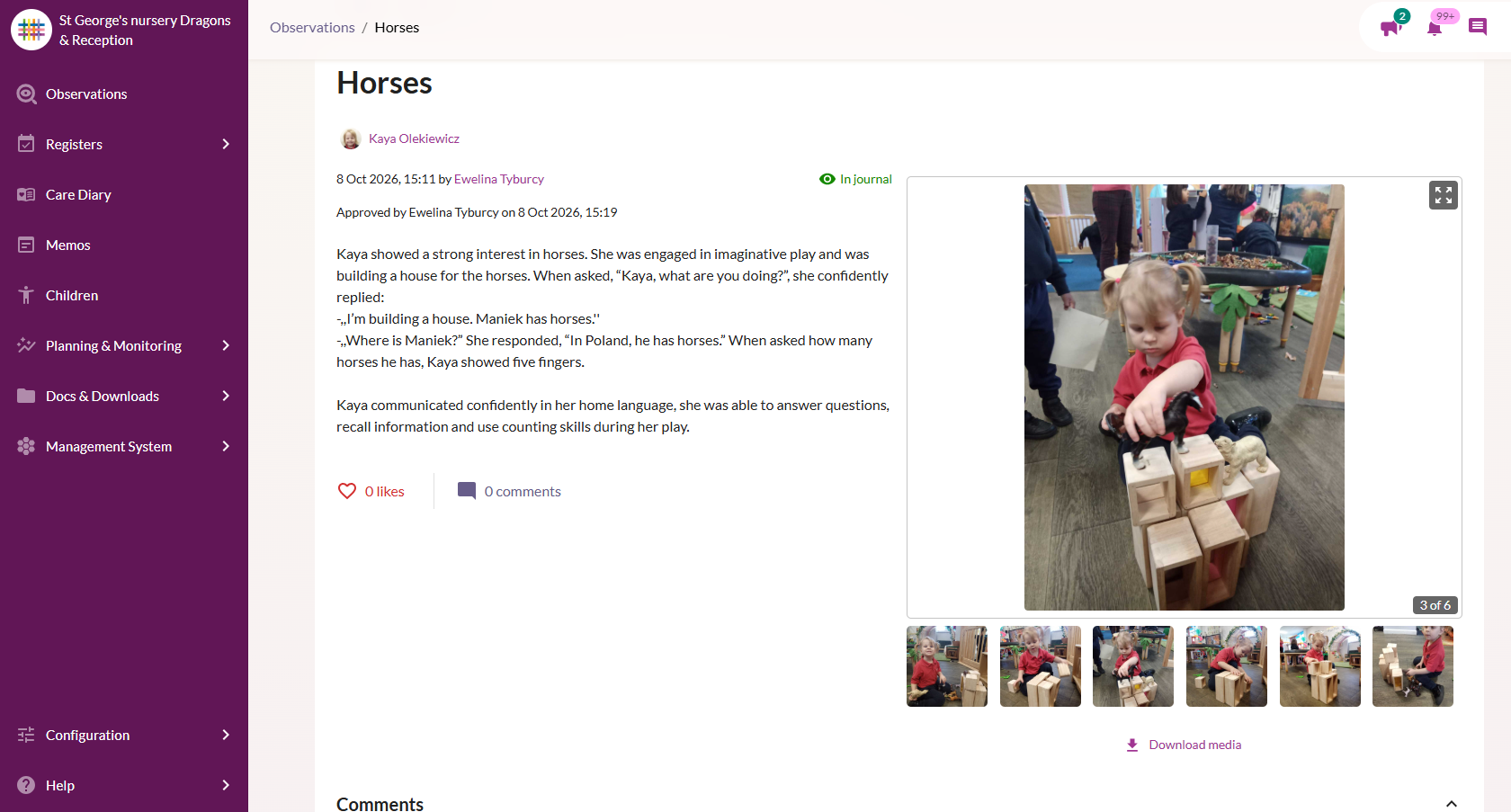
This partnership between home and nursery helps us create a complete picture of your child's development and ensures learning is meaningful, consistent and personalised.
Planning for Individual Children
Every child is unique, and our planning reflects this. Rather than following a fixed programme, our practitioners use ongoing observations, professional knowledge and discussions with families to plan experiences that build on children's interests, strengths and next steps.
Planning is:
- Child-centred and responsive to children's interests.
- Based on careful observations and assessment.
- Informed by Birth to 5 Matters guidance.
- Focused on developing confidence, independence and wellbeing.
- Flexible to respond to children's changing interests and developmental needs.
Working Together
We value the knowledge that parents have about their children. Throughout the year we invite families to share their child's interests, achievements, experiences and any significant events from home. This information helps us provide learning experiences that are relevant, enjoyable and meaningful.
Your child's Key Person will work closely with you to ensure your child feels safe, settled and supported throughout their time at nursery. Together, we create the best possible foundations for your child's learning, development and future success.
Through our strong partnership with families and the use of Tapestry, we can celebrate every child's unique learning journey and ensure they receive the personalised support they need to thrive.